30 Days – Day #20: A Hobby Of Mine

I skipped past photography yesterday. I’ve talked about roleplaying before. That’s the big two out the window, right there. I’m honestly not sure that blogging counts as a hobby, and nor does pissing about on the internet. So here’s a thing it honestly surprises me to be writing about: cooking.

I love food, this much is no secret. I like to eat in posh restaurants (and less posh restaurants – good food is good food, and it doesn’t have to be fancy), and I can talk about tastes and flavours in a pretty convincing manner.

But in the last year or so I’ve started to take more pleasure in cooking than I ever have before – it used to be something I didn’t do, then it became something I did because I liked the end product, even if I didn’t enjoy the actual process, but of late I find myself taking pleasure in the cooking itself.

I’m not a very skilled cook, especially not compared to the huge list of Serious Cooks among my group of friends, and doubt I ever will be, but as long as a recipe doesn’t require much of an attention span or any particularly difficult culinary tricks, I seem to do OK. I did black pudding with caramelised apple, and a cider reduction a few weeks ago, and some basic marinaded pork with peaches turned out so well I made it again the following night. Given that a year ago, I basically cooked the same three pasta dishes a lot (and I still do, because they are bloody tasty) I count this as progress. I made a sage and rosemary butter for the first time last night to go with some pre-purchased venison tortellini, and while it hardly counts as cooking, as it basically required me to melt some butter and throw some herbs in it, then add lemon juice once it was off the heat, it was still something I’d never done before, and will be doing again.

I guess the big difference from before would be that a year or two ago, I cooked what I cooked, and that was it, but now, I’m much more willing to give something new a go, and even once I have, I find myself thinking of other dishes I could so something similar with, or wondering “what would happen if I replaced the sage with…” Not everything works, but before when it didn’t work, I’d have given it up as a sign that I couldn’t cook, but now I tend to make a note of what not to do, and think of another approach – I tried to do a pancake filling made of plums and bananas that didn’t end well (came out bloody tasty, but it was essentially a mess of disintegrated plums combined with sugar, butter and rum with some sliced bananas floating in it – it was tasty, but it wasn’t what I wanted) and I’ve got a pasta sauce involving mushroom and black pudding that I haven’t got right yet – I’m trying to get little cubes of black pudding to crisp up to provide texture as well as flavour, but they either come out soft, or they totally disintegrate into the sauce. But I know what I’m going to try next time…
30 Days – Day #19 – A Talent Of Mine

I take pretty pictures. I’m sorry this isn’t a longer entry, but I’ve had a busy Saturday already, I have a cold, and I urgently want to take to my bed in order to prevent said cold from wrecking me, because I have stuff to do tomorrow, and I’ve got to be in work next week. So you get a short entry, with instructions to go and look at my photoblog instead, and with any luck, I’ll be feeling a bit better by tomorrow.

Links For Friday 18th December 2009

30 Days – Day #18: Design

There’s been a lot of stuff about Art in this meme. There’s been precious little about Design in it. I like design, and back in the early days of this iteration of this blog, I spent a short while explaining what I think its relationship to Art is.

So having skipped past the need for that re-cap, I thought I’d now witter on a bit about what sort of design I like, and I thought I’d start with a couple of links to designers I know.

Phil Clandillon. I worked with Phil in a little yellow room in Acton. Dark Days. Phil’s particular knack is coming up with really interesting and clever shit using unexpected technologies. The Kasabian “Football Hero” video was him, as was the AC/DC music video that was an Excel spreadsheet, as were a few other clever things that you can find out about at his portfolio there. What I like about Phil’s best work is the strength of his ideas – the execution’s important, too, but I like the fact that Phil isn’t just turning out websites any more, but is in a place where he can come up with genuinely orginal stuff that pulls in all sorts of digital media, and generally makes me think “I wish I’d thought of that”.

BERG. BERG is the sort of place that I would love to work for, but quite frankly, am not clever enough to do so. What I love about their work is twofold: one, is that it tends to be cutting edge, at least in terms of thinking, if not technology, and two, that it tends to be made the with the aim of enabling people to do things – they’re makers, rather than marketers. Also, how can you not love an agency who named themselves after of something out of Quatermass?

Between those two, I find I’ve very neatly encapsulated what I love about design – it’s the means by which people’s ideas shape the world, and bit by bit, change our lives. Here at the start of the 21st century, if you’re not engaged with design as a (very broad) field on some level, I do kind of wonder what you’re doing with your life, apart from taking up resources that the rest of us could be making better use of.

So that’s design as idea, and design as world-shaper, which is all vitally important background, but what about aesthetics? After all, that’s what most people think of when they think of design.

Well, I only really qualified to talk about my own sense of aesthetics, and me, I’m a pretty unabashed Swiss modernist. Give me clean, clear lines, plenty of white space, and attention to simple detail in the service of clarity. Sure, I can appreciate the cluttered, hand drawn and grungy look – I quite like the work of people like Courtney Riot or Christopher Cox, but honestly, give me plain black text, well spaced, on a white background every time – a bit of simple elegance. If I had to pick my favourite font, it’d be Helevetica Neue – just about the only font face that is more precise and tidier than Helevtica.

This applies in just about everything from ink on paper to products to architecture – I love simple clear lines and an absence of clutter. Those who have seen the spaces I inhabit and the general state of my desk are probably laughing themselves sick right now, to which I can only remark that very often, really good design is an aspirational thing.

30 Days – Day #17: An Art Piece

Well, I’ve talked before about one my favourite works of art, Marcel Duchamp’s Fountain. So my obvious choice is out.

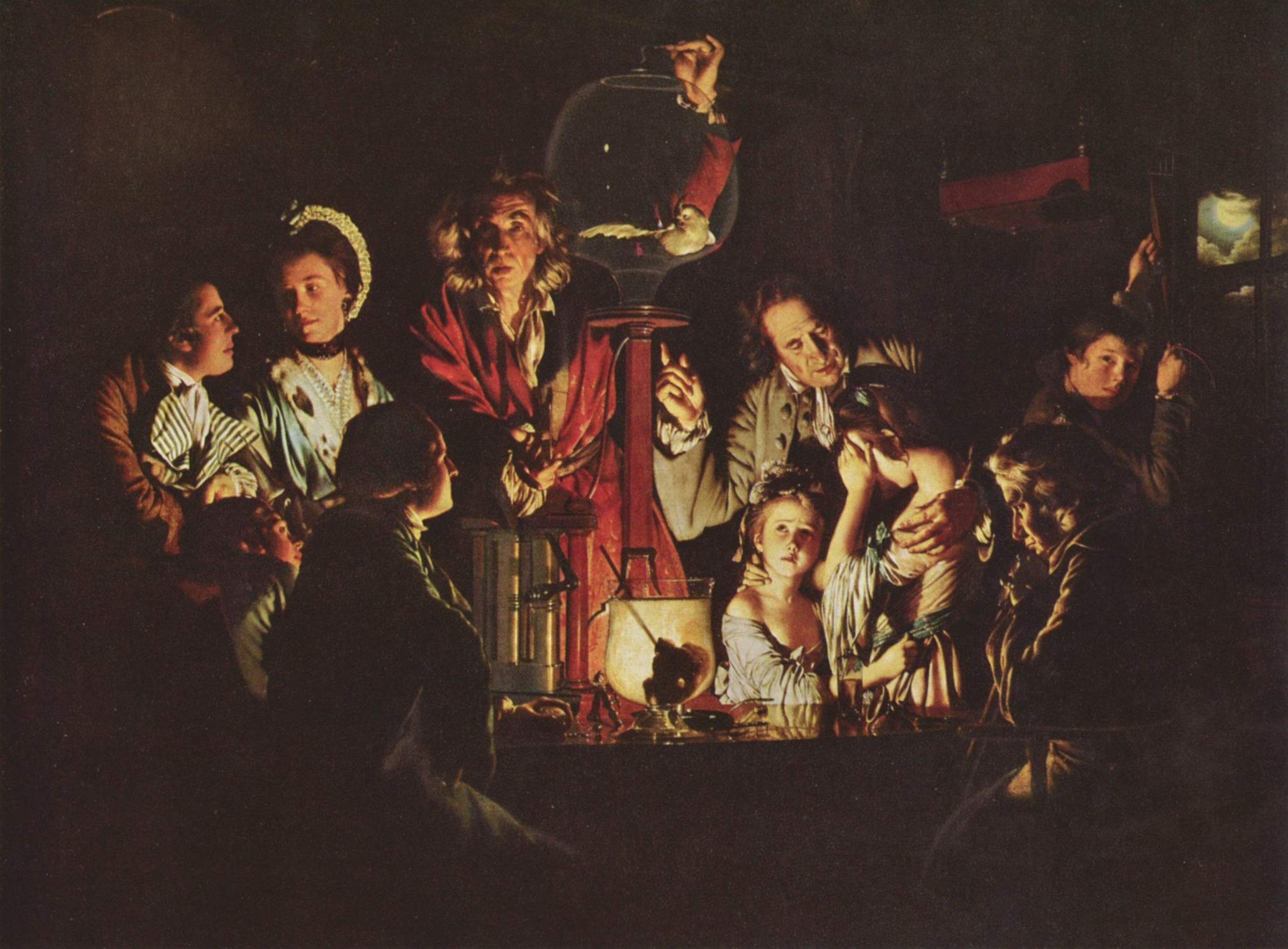
So let’s talk a little, instead, about my favourite painting, Wright of Derby’s “Experiment on a Bird in an Air Pump“. Mostly, what I love about it is the quality he’s given the light. I could stare at if for hours, just contemplating the use of light and shadow in that painting. But even aside from that, I like the themes, the way the different members of the audience are reacting to the progress of science, with expressions ranging from disgust to fascination.

I like the way that all the moral outrage in the painting is reserved not for the fate of the poor bird, but for the effect that the bird’s plight is having on the people watching it – how dare this scientist cause us distress? It seems to me to sum up a lot of the problem with people’s attitude to science, which is simultaneously that it can be terribly harmful to the natural world, but that the reality is most people don’t care about the harm, as long as it doesn’t cause them distress – that there’s a basic hypocrisy inherent in denouncing science and progress while living with the comforts that it has brought us all. Most of the figures in the painting are either unbothered by what is happening, and are far more wrapped up in the other people around the experiment, in some way of form.

I particularly like the fact the of all of them, it is only the scientist who is looking out of the picture, engaging with the viewer and the wider world.

Links For Tuesday 15th December 2009

  • This is unreal. I know that beat officers are getting more and more direction from above that harrassing photographers and videographers is not a crime, but seriously, I think there perhaps needs to be a bit more that that. Perhaps a total relaxation of the powers relating to photography, because that this can happen in London is just nauseating.
  • I have a soft spot for really, really tacky christmas ligt displays. I'm glad they're not as common here as they are in the US, but oen now and again is fun. This one, however, is *really* impressive.

30 Days – Day #15: Some Useful Background

So today’s meme-mandated topic is fanfic. I have nothing interesting or useful to say about fanfic – I haven’t read any in years. So I thought I’d talk about something that is at least slightly relevant to fanfic: copyright. Or rather, the history of copyright. I’m still working on what it turning out to be quite a long bit of writing about the Digital Economy Bill, and what I’m opening it with is a brief background on the history of copyright, which I thought might make good reading in any case…

Let’s start by admitting something: copyright is a good thing. That can get lost in all the shouting about piracy, and draconian measures and three strikes and creative commons and all the associated jargon. So it’s important to admit up front that copyright is a good thing, and the ideals it was created to protect are still good and valid today. We do need to provide a system to incentivise people to produce creative works, otherwise large parts of our culture will up and blow away. And it was in that spirit that copyright was first codified in England in 1709 by the Statute of Anne, or to give it it’s full title “An Act for the Encouragement of Learning, by vesting the Copies of Printed Books in the Authors or purchasers of such Copies, during the Times therein mentioned.” (Incidentally, in case anyone’s wondering what people did before copyright law was codified, then you’ll find that spending five minutes looking up the term “book curse” will pay interesting dividends.)

It gave creators rights over their work for 14 years after creation, and gave them the ability to extend those rights for another 14 years on application. It also expressly ensured that distributors retained no rights to control use of the material after first sale. If you bought a book, you were free to read it in public, sell it on, or use it as kindling if you so wished – so long as you didn’t make your own copies and distribute those, you were in the clear. But after that time was up, the works would pass into the public domain, for the common good.

I’m not going to bore you with the full history of copyright, I just wanted to bring up the full title of that 1709 act. The spirit in which copyright law was created was that of education, and of safeguarding the common good, to balance the rights of creators and of the public. The rights of distributors, however, were quite expressly limited.

But then, in 1709, there wasn’t a lot of demand for books. The person who printed the book was quite likely to also be the person who sold the book. And if someone in Edinburgh wanted a book that had been written in London, they either got a friend to in London to buy them a copy, or they wrote to the printer and asked them to post it. Distribution was not really something that people worried about.

But the world moved on, and a revolution or three later, people in Edinburgh expect to be able to buy not just books, but CDs and films made and published not just in London, but in New York, or Beijing or Sydney. And over the last hundred years or so, distribution has become very, very important. Entire industries have been founded on the fact that actually, the job of creating and printing something is the least difficult bit of the process, and that the hardest part was first making people aware of the product, and then getting the product into the hands of people who might want to buy it. And copyright law changed because it served the common good to ensure that the people who did the marketing and distribution were incentivised to do so.

And then we invented the internet. And now my friends can make films, and write books and record music in their own homes, and with a little effort, they can tell people all over the world about them, and they can sell them to anyone that’s interested. Suddenly, marketing and distribution are the easiest part of the process.

And that’s where things start to go wrong, because there are now entire industries that are rapidly becoming irrelevant who can only remain relevant by appointing themselves as gatekeepers of what can be done with created works. And that’s the background to the Digital Economy Bill.